
For the jury
Moûsa in one minute
Moûsa is a plugin for the design agents teams already use. Before the agent designs anything, it writes down and seals its own guess about the audience. Qloo then measures that audience, and every design choice has to rest on what the guess missed. Each session ends with a record that sets the guess beside the measurement.
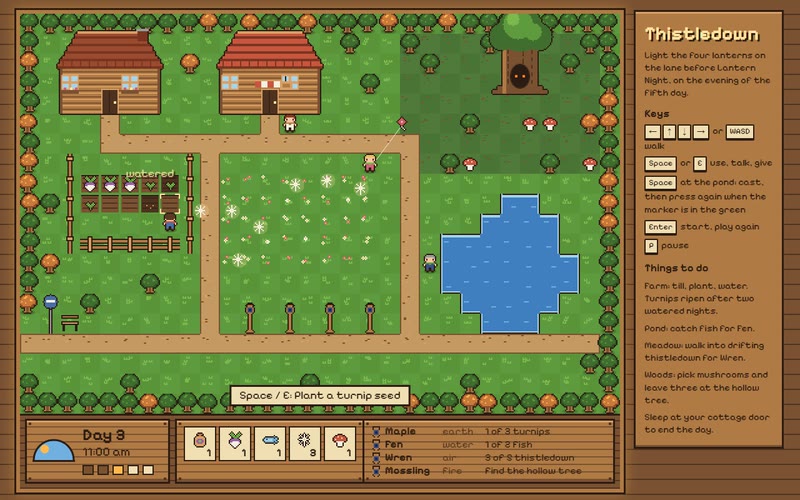
tilling, planting and wateringfishing with the timing barLantern Night
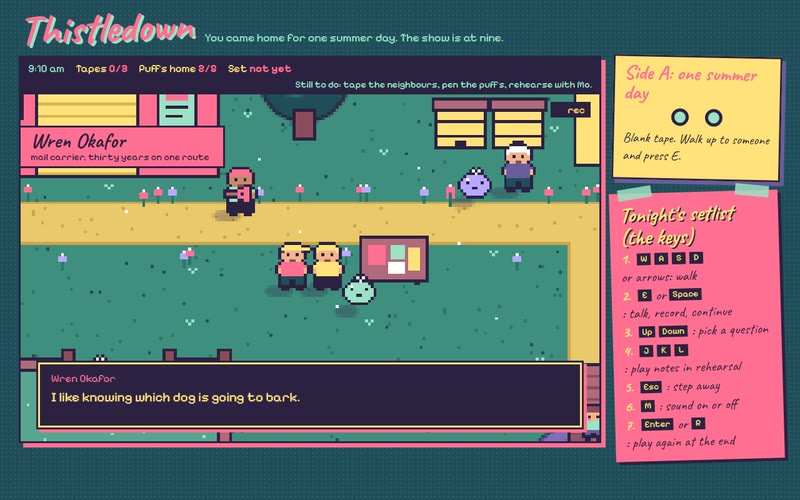
herding puffs into the pena tape-recorded interviewthe band rehearsal
Both designs as they play in a browser: a script sets up each scene and presses the game's own keys, scene for scene; each clip runs 11 seconds. Play both, and read the record
94.0%of the works Qloo measured were missing from the AI agents' own sealed guesses, pooled over the 60 runs of the pre-registered benchmark: 20 audiences, each guessed by Claude Code, Codex and Kiro. The guesses were shorter lists, which caps that share; the other way round, 245 of the 1,592 works they guessed (15.4%) were among those measured.
96.2%of the works Qloo measured were missing from the agents' own frozen guesses: 1,556 of 1,618, in 24 recorded sessions.
10.4%of the works the agents guessed turned up in Qloo's measurement: 62 of 597.
A path through the evidence
Each step stands on its own; the first three take under four minutes.
- Look at one pair. Thistledown, an RPG from one sentence: play the design made from the agent's guess and the one made from Qloo's measurement, side by side.
- Read its record. The same page shows the sealed guess, the names Qloo measured marked new or predicted, and each design device traced to the names it rests on.
- Try your own audience. Open the live try, which asks for no code, and name two or three works you love. In under a minute Moûsa shows Kiro's sealed guess beside Qloo's measurement. Building both designs takes about five to ten minutes more, and is optional.
- See the benchmark. Twenty audiences, three agents, with the predictions published before Qloo measured anything.
- Vote blind. Which design would the audience rather have? You see which one used Qloo only after you vote.
What the evidence shows, and what it does not
Five kinds, from the simplest count to a preference. Each says how strong it is and where it stops.
- 1
The blind spot
In 24 recorded sessions in Claude Code, Codex and Kiro, the agents' frozen guesses named 62 of the 1,618 works Qloo measured, and 62 of the 597 works they guessed were measured.
Why it holds: Counted from each session's own record; anyone can recount them from the release's gallery bundle with scripts/blind-spot-stats.mjs.
What it does not show: The sessions share a few audiences, and Qloo measures more works than an agent names, so the share is bounded by the two list sizes. It says nothing yet about the design.
- 2
The pre-registered benchmark
Over 20 audiences, the share of measured works each agent's sealed guess already named: Claude Code 6.8%, Codex 4.7%, Kiro 6.6%.
Why it holds: Protocol, amendments and predictions are public and dated; every run is reported, whatever it shows.
What it does not show: One prompt, one brief and one run per agent and audience. Qloo's measurement is aggregate affinity, not ground truth about any person.
- 3
The mechanism
16 recorded pairs, each built twice from one frozen guess: once with Qloo's measurement, once from the guess alone. Distance between the two designs: 0.53 to 0.74. The protocol requires the names the guess missed to change the Qloo design's palette, type and structure; in 14 of them every device rests on such a name. In an exploratory audience swap (one record shop, four audiences), each Qloo design moved 0.67 from its own guess-only design on average, further than the guess-only designs of different audiences were apart (0.59).
Why it holds: Both arms share the brief, the guess and every stage; only the source of the taste differs.
What it does not show: The distance is a heuristic over palette, type, structure and CSS, from 0 (alike) to 1 (unrelated). It does not rate quality.
- 4
Beyond the model's own variance
Repeated pairs of one website brief (3 October, 12 generations): the blind sketches of both arms showed no detectable difference (p = 0.81), and after Qloo the typography, structure, palette and overall distance separated beyond the model's variance (exact permutation test, p = 0.005 each). For game characters, the finished characters separated (p = 0.0079) while the blind sketches did not.
Why it holds: Both arms start from comparable blind sketches. Only the Qloo arm is asked to move from its sketch, with what Qloo measured, and the test shows the move is more than the model's own variance.
What it does not show: The move is required by the protocol, so this shows that the measurement changes the design, not that the change is better. One brief and one model per study; recorded in the development notes.
- 5
Preference
The blind vote shows a visitor both designs of a pair without saying which used Qloo, and asks which the audience would rather have.
Why it holds: Ballots are sealed; the results page counts every vote.
What it does not show: Visitors choose themselves and are few (none so far); it is not a study of the audience.
How Moûsa uses Qloo
Search to resolve the audience's names, Insights across films, music, books, TV, brands, podcasts, games and places, and tag rankings for the qualities those works share: at most 24 requests a session, cached for a week. Request by request, and what the live API taught us.
How it is built
One MCP server in Node 22 with no dependencies, packaged for three hosts from one source; a write gate that holds a design until its Design DNA is valid; checks through the project's own CSS variables, tokens or Tailwind theme; captures in a sandboxed headless Chromium; more than 500 tests on Ubuntu and Windows; this site on one AWS stack. The source.